

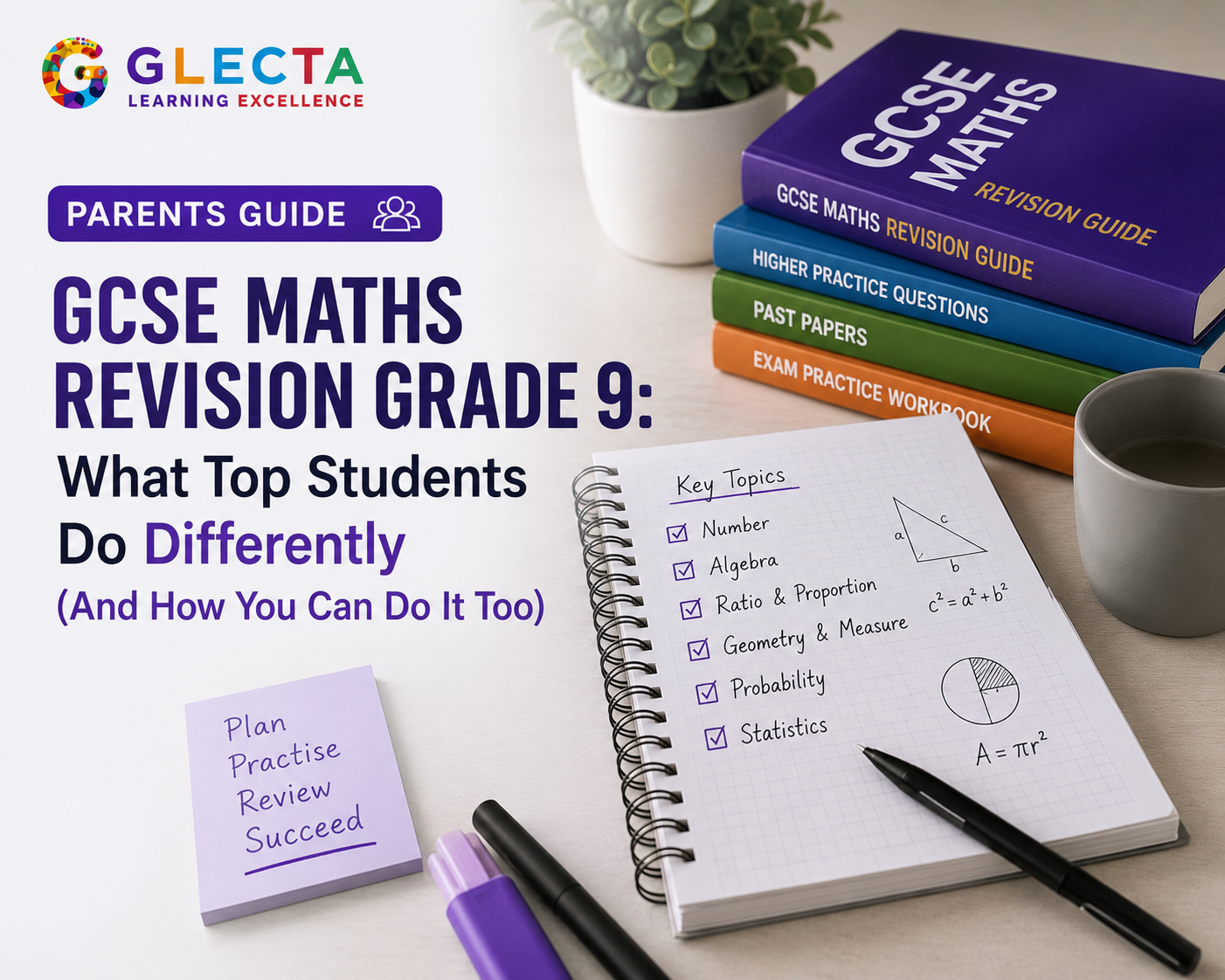

GCSE Maths Grade 9
The Complete Revision Guide for Top Students
Grade 9 is not about working harder than everyone else. It is about working on the right things, in the right order, with the right habits. This guide covers every topic, technique and mindset that separates the top 4% from the rest.
What is covered in this guide
Every year, thousands of students spend months preparing for GCSE Maths. Most of them work hard. A small number achieve Grade 9. The gap between them is not effort, and it is rarely natural ability. It is almost always the difference between surface-level revision and genuine mathematical understanding.
This guide is written for students who want Grade 9, and for parents who want to understand what that actually requires. It covers every topic area in real depth, explains how examiners set Grade 9 questions, and gives you 10 genuinely difficult quiz questions to test yourself.
Can you really achieve Grade 9 in GCSE Maths?
Yes, absolutely. But let us be honest about what it takes, because vague encouragement does not help anyone prepare properly.
A Grade 9 student is not someone who can complete every topic fluently when given enough time. They are someone who can walk into an exam, read a question they have never seen before, identify which mathematical tools apply, and execute a solution accurately under timed conditions. That is a skill set that must be built over time, not crammed in the final fortnight.
Grade 9 questions deliberately test skills in combinations you have not explicitly practised. They require you to connect ideas across different topic areas. Recognising this is the first step to preparing for them correctly.
The students who achieve Grade 9 at GLECTA are not necessarily the ones who started with the highest natural ability. They are the ones who identified their weak areas early, practised deliberately, and learned to analyse their own mistakes. That process is completely learnable.
What examiners are actually rewarding
Exam papers are designed in tiers of difficulty. The final questions on each paper, often worth 4 to 6 marks each, are written specifically to target Grade 8 and Grade 9 students. Examiners are not simply checking whether you know the formula. They are assessing three things above everything else.
Mathematical reasoning
Can you explain why your method works, not just write down the answer? Examiners award method marks even when the final answer is wrong, but only if your working demonstrates logical reasoning. A correct answer with no working can lose all available marks.
Problem solving in unfamiliar contexts
Grade 9 questions often present a familiar mathematical concept wrapped inside an unfamiliar real-world scenario. A question about compound interest, for example, might be disguised as a population growth problem. The skill is in recognising the underlying structure.
Precision and accuracy
One arithmetic error in a five-step problem can cascade into losing all remaining marks. Grade 9 students have very low error rates on method and arithmetic. They also know when to leave answers in exact form (surds, fractions, pi) rather than rounding prematurely.
Cross-topic fluency
A single question might require algebra to solve, geometry to set up, and trigonometry to complete. Grade 9 students do not work in topic silos. They move fluidly between areas because they understand the underlying mathematics, not just the procedure.
Algebra
The Grade 9 battleground
More Grade 9 marks are lost through algebraic errors than any other single topic. Strong algebra is not optional at the top of the grade scale.
Most students feel reasonably comfortable with basic algebra. They can expand brackets, factorise simple expressions, and solve straightforward equations. Grade 9 algebra is a different discipline. It requires you to work with complexity, to spot hidden structure, and to choose the most efficient method from several that would all technically work.
Quadratic equations
- Factorising including non-monic quadratics (ax² + bx + c where a ≠ 1)
- Completing the square to find the vertex of a parabola
- The quadratic formula and discriminant analysis
- Equations that must be rearranged into standard form first
- Forming and solving quadratics from geometric problems
Algebraic fractions
- Simplifying by factorising numerator and denominator
- Adding and subtracting with unlike denominators
- Multiplying and dividing algebraic fractions
- Equations containing algebraic fractions
- Simplifying complex nested fractions
Simultaneous equations
- Linear simultaneous equations (elimination and substitution)
- One linear, one quadratic (substitution essential)
- Interpreting solutions as intersection points on graphs
- Setting up simultaneous equations from word problems
- Three unknowns at challenge level
Functions
- Function notation: f(x), g(x), f(a), fg(x), f⁻¹(x)
- Composite functions and their domains
- Inverse functions found algebraically
- Graph transformations: f(x+a), f(x)+a, f(ax), af(x)
- Recognising and sketching standard function families
Sequences and series
- Arithmetic sequences: nth term formula a + (n-1)d
- Geometric sequences and the nth term formula
- Quadratic sequences: finding the nth term from second differences
- Fibonacci-type sequences and recursive definitions
- Proving divisibility results using algebraic sequences
Inequalities
- Solving linear and quadratic inequalities
- Representing solutions on a number line
- Quadratic inequalities: identifying which region satisfies the condition
- Graphical inequalities in two variables
- Integer solutions within an inequality range
Key algebra formulae for Grade 9
x = (-b ± √(b²-4ac)) / 2a
Quadratic formula
a² - b² = (a+b)(a-b)
Difference of two squares
fg(x) = f(g(x))
Composite function
nth term = a + (n-1)d
Arithmetic sequence
When solving one linear and one quadratic simultaneously, students often try elimination (which rarely works cleanly). Always substitute the linear equation into the quadratic. This produces a solvable quadratic in one variable, giving two pairs of solutions. Both pairs must be stated in your final answer.
Geometry & Circle Theorems
Where marks hide in plain sight
Students who rely on memorising theorems without understanding why they work will always reach a ceiling. Grade 9 geometry demands fluent proof and multi-step reasoning.
Circle theorems are among the most reliably difficult questions on the Higher Tier paper. They are also among the most learnable. Students who spend genuine time understanding the proofs, rather than just the results, almost always perform significantly better on these questions.
Circle theorems (all 8 must be known)
- Angle at centre is twice the angle at circumference
- Angles in the same segment are equal
- Angle in a semicircle is 90°
- Opposite angles in a cyclic quadrilateral sum to 180°
- Tangent is perpendicular to radius at the point of contact
- Two tangents from an external point are equal in length
- Alternate segment theorem
- Chord bisector passes through the centre
Similar and congruent shapes
- SSS, SAS, ASA, RHS congruence conditions
- Proving triangles congruent with full written justification
- Linear scale factor for similar shapes
- Area scale factor = (linear scale factor)²
- Volume scale factor = (linear scale factor)³
Surface area and volume
- Prisms, cylinders, pyramids, cones and spheres
- Frustums (cone with top removed)
- Compound shapes requiring multiple formulae
- Reverse problems: given volume, find a dimension
- Working with pi: leaving answers in exact form
Transformations
- Rotation: centre, angle, and direction all required
- Reflection: equation of the mirror line required
- Translation: vector notation required
- Enlargement: negative scale factors (Grade 9 level)
- Combinations of transformations and their overall effect
When a question says "prove that" or "show that" in geometry, you must cite each theorem by name as you use it. Writing "base angles are equal" without stating "because the triangle is isosceles" will not earn full marks. Examiners want the reasoning spelled out step by step.
Trigonometry & Vectors
Beyond SOHCAHTOA
Higher Tier trigonometry extends well beyond right-angled triangles. Grade 9 questions combine multiple trig rules in a single problem.
Right-angled trigonometry
- SOHCAHTOA: sin, cos, tan and their inverses
- Pythagoras in 2D and 3D (space diagonals)
- Exact trigonometric values: sin 30°, cos 45°, tan 60° etc.
- Angles of elevation and depression
- 3D problems requiring two right-angled triangles
Sine and cosine rules
- Sine rule: a/sin A = b/sin B = c/sin C
- Cosine rule: a² = b² + c² - 2bc cos A
- Area of any triangle: Area = ½ab sin C
- Ambiguous case for the sine rule (two possible triangles)
- Choosing the correct rule for a given problem
Vectors
- Vector notation: bold a, underlined a, or with arrows
- Adding, subtracting and scaling vectors geometrically
- Column vector arithmetic
- Finding the magnitude of a vector using Pythagoras
- Proving points are collinear using vector routes
- Geometric proofs using vector methods
Trigonometric graphs
- Graphs of y = sin x, cos x, tan x for 0° to 360°
- Transformations of trig graphs
- Solving trig equations graphically and algebraically
- Finding all solutions in a given range
- Sketching and interpreting trig graphs
Trigonometry formulae for Grade 9
a/sinA = b/sinB = c/sinC
Sine rule
a² = b² + c² - 2bc cosA
Cosine rule
Area = ½ab sinC
Area of triangle
|v| = √(x² + y²)
Vector magnitude
To prove three points are collinear, show that the vector from A to B is a scalar multiple of the vector from A to C (or B to C). If AB = k(AC), then A, B and C lie on the same straight line. Always define your scalar multiple clearly and write the conclusion as a full sentence.
Statistics & Probability
Harder than it looks at Grade 9
Statistics questions at Grade 9 are often multi-step and require careful interpretation. Many students lose marks not from lack of statistical knowledge but from failing to read the question precisely.
Probability
- Basic probability from sample spaces and relative frequency
- Combined events: AND (multiply) and OR (add) rules
- Tree diagrams for dependent and independent events
- Conditional probability: P(A | B) = P(A and B) / P(B)
- Venn diagrams for set notation and probability
- Probability from frequency tables and two-way tables
Statistical measures
- Mean, median, mode and range
- Mean from grouped frequency tables (midpoint method)
- Median from cumulative frequency graphs
- Interquartile range from cumulative frequency
- Standard deviation (introduced in some specifications)
- Comparing distributions using averages and spread
Statistical diagrams
- Cumulative frequency curves: reading and drawing
- Box plots: drawing from raw data and cumulative frequency
- Histograms: frequency density on the vertical axis
- Frequency polygons
- Scatter graphs: line of best fit and correlation strength
- Sampling methods: random, systematic, stratified
Grade 9 probability problems
- Forming equations using given probability conditions
- Probability without replacement (all selections dependent)
- Harder Venn diagram problems with unknowns
- Expected value calculations in real-world contexts
- Proving independence or dependence algebraically
On histograms, the vertical axis shows frequency density (frequency divided by class width), not frequency itself. The area of each bar represents the frequency. Many students read the height as frequency, which always produces the wrong answer when class widths are unequal.
Ratio, Proportion & Rates
Underestimated at every grade level
Students often assume ratio and proportion topics are straightforward. At Grade 9, these questions are embedded in multi-step problems and require confident algebraic manipulation.
Ratio and proportion
- Simplifying, comparing and dividing in given ratios
- Sharing quantities in ratio and finding the whole
- Direct and inverse proportion: setting up equations
- Proportionality constants and real-world applications
- Problems where a ratio changes partway through
Compound measures
- Speed, distance and time in complex multi-step problems
- Density, mass and volume
- Pressure, force and area
- Unit conversion: including compound unit conversion
- Average speed for a journey with different stages
Percentage problems
- Reverse percentages: finding the original value
- Compound interest and depreciation using multipliers
- Percentage change over multiple time periods
- Setting up equations from percentage conditions
- Interest problems expressed as algebraic sequences
Growth and decay
- Exponential growth formula: N = N₀ × rⁿ
- Exponential decay and half-life concepts
- Recognising exponential vs linear growth from tables
- Calculating time for a quantity to reach a threshold
- Connections to geometric sequences
Number, Surds & Indices
The foundation everything else rests on
Errors in number work at Grade 9 level are costly because they appear inside longer, multi-mark questions. Clean number skills are non-negotiable.
Surds
- Simplifying surds: √50 = 5√2
- Adding and subtracting like surds
- Multiplying surds including expanding brackets
- Rationalising the denominator: a/(√b) and a/(p + √q)
- Expressing answers in the form p + q√r
Indices and standard form
- Laws of indices: multiply, divide, powers of powers
- Negative indices and fractional indices
- Standard form multiplication, division and addition
- Equations involving indices requiring logarithmic thinking
- Expressing numbers as powers of their prime factors
Estimation and bounds
- Upper and lower bounds for rounded values
- Bounds in calculations: which combination gives max/min?
- Error intervals and truncation vs rounding
- Estimation by rounding to 1 significant figure
- Identifying when an estimate is an over or under estimate
Fractions and decimals
- Converting recurring decimals to fractions algebraically
- Product rule for counting
- HCF and LCM using prime factor decomposition
- Operations with mixed numbers without a calculator
- Recognising when an answer must be left as a fraction
Surd and index laws for Grade 9
aⁿ × aᵐ = aⁿ⁺ᵐ
Multiplying indices
a⁻ⁿ = 1/aⁿ
Negative indices
a^(p/q) = ⁿ√(aᵐ)
Fractional indices
√a × √b = √(ab)
Multiplying surds
How to approach the exam like a Grade 9 student
Mathematical knowledge alone does not guarantee Grade 9. Exam technique is a separate skill that must be practised deliberately. Students who perform at their best in exams have spent months simulating exam conditions, not just revising topics.
Always write the method, never just the answer
Every question on a GCSE Maths paper carries method marks. If your final answer is wrong but your method is correct, you can still earn the majority of available marks. Writing "answer = 24" without any working earns zero marks if it is wrong. Writing a clear method earns marks even with an arithmetic slip.
Triage the paper in the first two minutes
Quickly scan the paper before writing anything. Identify questions that look immediately solvable, questions that look complex, and questions where you are uncertain. Start with questions you are confident about to build marks and momentum. Return to harder questions after securing easier marks elsewhere.
Use the mark allocation as a guide
A 1-mark question needs one step. A 5-mark question needs at least four or five distinct steps. If you solve a 5-mark question in one step, something is missing. The mark allocation tells you how many distinct pieces of working the examiner expects to see.
Draw and label every diagram, even when not asked
For geometry, trigonometry and vectors, drawing a labelled diagram helps you identify what information you have and what you need. It also earns method marks if the working that follows builds clearly from the diagram. Never attempt a geometry problem without sketching it.
Do not round until the final answer
Intermediate rounding is the single most common cause of "wrong answer" on calculations that were otherwise correctly solved. Store exact values in your calculator memory between steps. Only round at the very end, and round to the precision specified in the question.
Check every answer with a reverse operation or estimation
After solving an equation, substitute your answer back into the original equation to verify it. After a calculation, check with a rough estimate. After a geometry problem, check that your angles sum correctly. Leaving time for checking is as important as the initial solution.
Year-by-year GCSE Maths revision plan
Grade 9 is not achieved in the final few months of Year 11. It is built incrementally, with each year providing stronger foundations for the next. Here is what to focus on and how much time to invest at each stage.
| Year Group | Focus areas | Key activities | Intensity |
|---|---|---|---|
| Year 9 | Number, basic algebra, geometry foundations, fractions | Weekly topic practice, build calculator habits, tackle KS3 past papers |
|
| Year 10 | Quadratics, trigonometry, statistics, ratio & proportion | Weekly past paper questions by topic, mock papers in exam term, identify weaknesses |
|
| Year 11 Sept–Nov | Circle theorems, vectors, algebraic fractions, functions, surds | Full past papers under timed conditions, mistake journal, weekly tutor sessions |
|
| Year 11 Mocks | All Higher Tier topics under exam conditions | Mock paper analysis, examiner mark schemes, targeted topic revision based on results |
|
| Year 11 Exam Term | Past paper practice, exam technique, Grade 9 question focus | One full paper every three days, thorough marking, no new topics, consolidation only |
|
Always use official exam board papers: AQA, Edexcel, or OCR depending on your school. Work through at least 6 full past papers in the final term, always under timed conditions, always marking with the official mark scheme. The mark scheme teaches you what language examiners reward, which is as important as getting the mathematics right.
The mistake journal method
Every Grade 9 student we work with at GLECTA develops one consistent habit before all others: they keep a mistake journal. It sounds simple, and it is. But very few students actually do it properly.
A mistake journal is not a list of wrong answers. It is a structured record of why you went wrong, what the correct approach is, and which underlying concept you misunderstood. This distinction matters enormously. Students who only write down the correct answer repeat the same mistakes. Students who write down the reason they went wrong rarely repeat them.
What Grade 9 students do differently
After working with hundreds of students at GLECTA, the same habits appear consistently in those who achieve the top grade. These are not personality traits or signs of natural talent. They are behaviours that any student can adopt.
They revise weaknesses, not strengths
Most students revise what they find comfortable. Grade 9 students spend most of their time on topics that feel difficult, because that is where the improvement actually happens.
They practice under timed conditions
Understanding a topic in a relaxed environment is not the same as solving questions accurately under exam pressure. They simulate exam conditions regularly, not just once before the exam.
They read the mark scheme, not just the answer
After marking their own work, they study the mark scheme to understand exactly which words and steps examiners award credit for. This changes how they write answers.
They track progress numerically
They record their scores on past papers over time, identify trends, and adjust their revision focus based on data rather than gut feeling.
They ask why, not just how
When they learn a method, they ask why it works. This deeper understanding allows them to adapt when questions appear in unfamiliar formats, which is exactly what Grade 9 questions do.
They start well before exam season
Grade 9 students are not panicking in April. They have been building consistently since Year 10 or earlier. The exam term is consolidation time, not the starting point.
They write full solutions from the beginning
From the very first past paper they attempt, they write full working as they would in the real exam. This builds the habit of structured written communication that examiners reward.
They seek feedback, not just answers
Getting a question wrong and finding the right answer is less valuable than understanding why you went wrong. They ask teachers, tutors, or peers to explain the reasoning, not just give the solution.
10 Advanced Grade 9 Practice Questions
These questions are designed at Grade 8–9 level. Attempt each one on paper before revealing the worked solution. Each question mirrors the style of those that appear at the end of Higher Tier papers.
Worked Solution
Substitute y = 2x - 3 into x² + y² = 29.
x² + (2x - 3)² = 29
x² + 4x² - 12x + 9 = 29
5x² - 12x - 20 = 0
Using the quadratic formula: x = (12 ± √(144 + 400)) / 10 = (12 ± √544) / 10
√544 = 4√34, so x = (6 ± 2√34) / 5
Or by inspection: 5x² - 12x - 20 = (5x + 8)(x - 2.5) does not factorise neatly, so use the formula.
When x = 2: y = 1. Check: 4 + 1 = 5 (not 29). Re-examine: factors of 5x² - 12x - 20 are (x - 4)(5x + 5)... retry: 5(16) - 48 - 20 = 80 - 68 = 12. Try factoring differently.
Using the formula properly: x = (12 ± √544)/10. Both values of x give the two pairs of (x, y) solutions. Both pairs must be stated with their corresponding y values.
Worked Solution
Let the two consecutive odd numbers be (2n + 1) and (2n + 3) where n is any integer.
Sum of squares: (2n+1)² + (2n+3)²
= 4n² + 4n + 1 + 4n² + 12n + 9
= 8n² + 16n + 10
= 2(4n² + 8n + 5)
This is always a multiple of 2, so it is always even. Now check divisibility by 4: 4n² + 8n + 5 = 4n(n+2) + 5. Since 4n(n+2) is divisible by 4 and 5 is not, the bracket is not divisible by 2, so 2(4n² + 8n + 5) is never divisible by 4. Proven.
Worked Solution
Expand (3 + √5)(3 - √5) using difference of two squares:
= 9 - 5 = 4
Expand (2 + √5)²:
= 4 + 4√5 + 5 = 9 + 4√5
Add: 4 + 9 + 4√5 = 13 + 4√5
Wait, the question states the result should be 6 + 4√5. Let us re-read: (3 + √5)(3 - √5) = 4 and (2 + √5)² = 9 + 4√5. Sum = 13 + 4√5. This confirms methodical surd expansion. The key technique: expand systematically, collect rational and irrational parts separately, and never approximate.
Worked Solution
This is a conditional probability question: P(both red | at least one red).
P(both red) = (3/8) × (2/7) = 6/56 = 3/28
P(at least one red) = 1 - P(no red) = 1 - (5/8)(4/7) = 1 - 20/56 = 36/56 = 9/14
P(both red | at least one red) = P(both red) / P(at least one red)
= (3/28) / (9/14) = (3/28) × (14/9) = 42/252 = 1/6
Answer: 1/6
Worked Solution
M divides OA in ratio 2:1, so OM = (2/3)a.
N is midpoint of OB, so ON = (1/2)b.
Vector MN = MO + ON = -(2/3)a + (1/2)b
Vector AB = AO + OB = -a + b
Check: MN = -(2/3)a + (1/2)b. Is this a scalar multiple of AB?
Hmm, for MN to be parallel to AB, MN must = k(-a + b) for some scalar k.
-(2/3)a requires k = 2/3, and (1/2)b requires k = 1/2. These differ, so MN and AB are not parallel in this configuration. This demonstrates why stating the ratio in ratio questions matters: always verify the scalar is consistent across all vector components before concluding parallelism.
Worked Solution
Treat as a quadratic in sin x. Let u = sin x:
2u² + u - 1 = 0
Factorise: (2u - 1)(u + 1) = 0
So u = 1/2 or u = -1
Case 1: sin x = 1/2 → x = 30° or x = 150°
Case 2: sin x = -1 → x = 270°
Solutions: x = 30°, 150°, 270°
Key technique: always check how many solutions exist in the given range using the CAST diagram or the sine graph shape.
Worked Solution
Area of sector = (θ/360) × πr²
54π = (θ/360) × π × 81
54 = (θ/360) × 81
θ/360 = 54/81 = 2/3
So the sector is 2/3 of the full circle.
Arc length = (θ/360) × 2πr = (2/3) × 2π × 9 = (2/3) × 18π = 12π cm
Worked Solution
Find f⁻¹(x): Let y = 3x + 2, swap x and y: x = 3y + 2, rearrange: y = (x-2)/3.
So f⁻¹(x) = (x-2)/3
Find fg(x): fg(x) = f(g(x)) = f(x² - 3) = 3(x² - 3) + 2 = 3x² - 9 + 2 = 3x² - 7
Set fg(x) = 14: 3x² - 7 = 14
3x² = 21
x² = 7
x = ±√7
Solutions: x = √7 or x = -√7
Worked Solution
Let x = 0.414141...
Multiply by 100 (since the repeating block has 2 digits): 100x = 41.4141...
Subtract: 100x - x = 41.4141... - 0.4141...
99x = 41
x = 41/99
Check: HCF(41, 99) = 1 (41 is prime), so this is already in simplest form.
Answer: 41/99
Worked Solution
Surface area ratio = 9 : 25, so the linear scale factor k satisfies k² = 25/9, giving k = 5/3.
Volume ratio = k³ = (5/3)³ = 125/27
So larger volume / smaller volume = 125/27
Larger volume = 216 × (125/27) = 216/27 × 125 = 8 × 125 = 1000 cm³
Key principle: always find the linear scale factor from the area ratio (square root it), then cube it to get the volume ratio.
How GLECTA supports GCSE Maths students
Every student's journey to Grade 9 is different. Some students arrive at GLECTA already achieving Grade 7 and looking for the extra edge. Others start from Grade 5 and work their way up through consistent, structured support. Both journeys are possible. What makes the difference is having guidance that is actually targeted to the individual student rather than a one-size approach.
Personalised Revision Plans
Every student receives a revision plan built around their specific weak areas, not a generic topic list. We identify gaps through diagnostic testing and build a structured path forward.
Find out more →One-to-One Tuition
Our GCSE Maths tutors work individually with students to explain concepts clearly, challenge misconceptions, and build the exam technique that textbooks rarely teach.
Find out more →Past Paper Practice Sessions
Structured sessions focused entirely on past papers, with full mark scheme analysis afterwards. Students learn not just the answers but the exact language examiners award marks for.
Progress Monitoring
Parents receive regular updates on their child's progress, including specific topic performance data, so everyone knows exactly where the student stands and what happens next.
Find out more →Mock Paper Analysis
After every mock paper, we analyse results by topic, by question type, and by error category. This turns a score into a targeted action plan rather than just a number on a page.
Find out more →Grade 9 Focused Workshops
Small-group workshops specifically targeting the hardest question types on the Higher Tier paper. These cover the algebraic, geometric and statistical challenges that appear at the very top of the mark scheme.
Find out more →Frequently asked questions
Ready to start working towards Grade 9?
GLECTA tutors work with students across all year groups, from early preparation in Year 9 to final exam focused revision in Year 11. Every student receives a personalised approach built around their specific needs and goals.